
It can be frustrating, because we know that we need sleep to rest our bodies and minds. If you are looking to help improve the quality of your sleep, ReDormin Forte may be right for you.
ReDormin Forte has been clinically researched for over 10 years to help relieve night time stress and tension while supporting a deeper, more restful sleep. ReDormin Forte works by helping to restore healthy sleep patterns over 2 weeks to get your sleep cycle back on track.1
Always read the label and follow the directions for use. If symptoms persist talk to your health professional.
Are you health professional? Register or sign in now to gain access to exclusive practitioner resources.

Significantly reduced time to fall asleep by 79% 2

Shown to triple the number of people staying asleep through the night without waking or waking only once 3

Researched to help restore healthy sleep patterns in 2 weeks and help improve sleep quality.1 4 out 5 people woke feeling refreshed 1
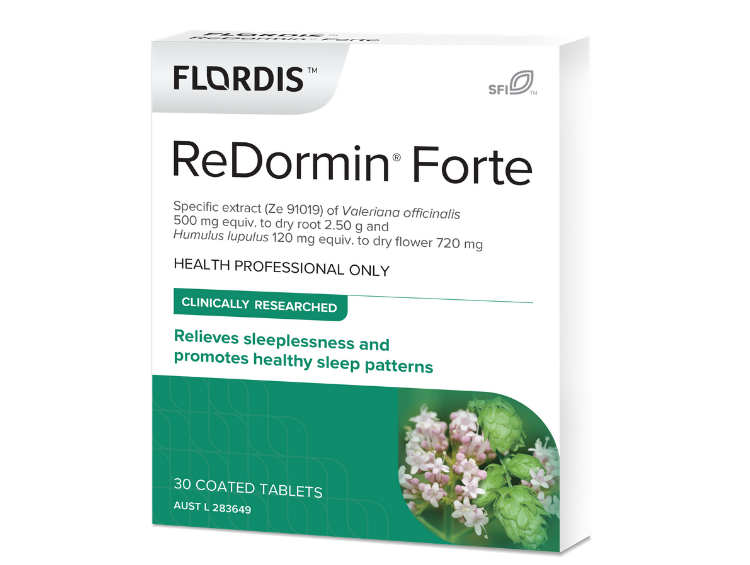
ReDormin Forte contains a specific combination of Valeriana officinalis (Valerian) and Humulus lupulus (Hops) – known as Ze 91019 – which has been clinically researched for over 10 years to help improve sleep quality and restore healthy sleep patterns over 2 weeks. 1-3
Food for thought: Did you know that 1 in 3 people have trouble sleeping? Find out more about how our dual action formula of Valerian and Hops can help to improve your quality of sleep.
Why are the details important?
The finer details of our medicines help ensure that you can feel confident that you are taking a reliable healthcare product. What you see in clinical studies is what you get in our products.
Adults and children 12 years and over: Take 1 tablet, 1 hour before planned bedtime with water, or as directed by your health professional.
Take ReDormin Forte for at least 2 weeks to help improve sleep quality and restore healthy sleep patterns, based on the research best results are experienced after 4 weeks of ReDormin Forte.
Research showed that 87% of patients reported sustained sleep benefits 4 weeks after they finished a 2 week course of ReDormin Forte. 1 Should you find your sleep disrupted again due to stress or lifestyle factors you may wish to take ReDormin Forte to help re-establish healthy sleep patterns.1
Always read the label and follow the directions for use. If symptoms persist talk to your health professional.
Each tablet contains Ze 91019 extract equivalent to dry:
Backed by 10 years of clinical research, ReDormin Forte contains a specific combination of herbal extracts known as Ze 91019 that has been shown to help restore healthy sleep patterns within 2 weeks. Recommended for over 20 years worldwide, ReDormin Forte’s dual action formula works by helping to reduce the time taken to fall asleep, and can help to re-establish healthy sleeping rhythms to help improve quality of sleep and the time spent in the deeper, restorative sleep stages – leaving you to wake up feeling refreshed.
Not all natural medicines are created equally, that’s why we take special care that the combination, Ze 91019, found in ReDormin Forte is the same medicine that has been tested in clinical studies. We want to ensure you receive the same high quality medicine that has been clinically researched to help restore healthy sleep patterns and to help get your sleep cycle back on track.
Take ReDormin Forte for at least 2 weeks to help improve sleep quality and restore healthy sleep patterns. Based on the research best results are experienced after 4 weeks of ReDormin Forte.
Research showed that 87% of patients reported sustained sleep benefits 4 weeks after they finished a 2 week course of ReDormin Forte.1 However, should you find your sleep disrupted again due to stress or lifestyle factors, you may wish to take ReDormin Forte to help re-establish healthy sleep patterns.
ReDormin Forte contains no added gluten, wheat, lactose or yeast.
There are no known reported interactions between ReDormin Forte and other medications. However, it is not recommended to take ReDormin Forte if you are currently taking sedative medication (such as Benzodiazepines).
It is recommended to talk to your healthcare professional if you have any concerns about interactions or questions about using ReDormin Forte.
Please contact us for further information.
ReDormin Forte may be used in children over 12 years of age. The recommended dosage is 1 tablet 1 hour before bed. If you have specific questions or concerns, it is important to speak with a healthcare professional.
Yes, ReDormin Forte is vegan friendly as it contains no animal-derived ingredients.
ReDormin Forte is not recommended during pregnancy or breastfeeding as there are no published studies to establish its safe use during pregnancy or while breastfeeding. Your healthcare professional can discuss with you the risks and benefits involved in taking ReDormin Forte during these life stages.
It is important to discuss this with your healthcare professional, including your anaesthetist and surgeon.
For consumers: ReDormin Forte is available from natural health practitioners, leading pharmacies and health food stores or can be ordered directly from us on our website.
If you prefer to find it in your area, click the Find SFI Health button above and follow the instructions, you will be able to find a list of places close by that either stock it or will know how to order it in. Even if your local health food store or clinic is not on the list, most will be able to order ReDormin Forte in for customers when requested.
Within health food stores and pharmacies, ReDormin Forte can be found within the professional services section or behind the pharmacist’s dispensary counter.
For health professional dispensaries: The SFI Health range of integrative medicine can be ordered at most leading natural health care distributors. Learn more.
References
ReDormin® Forte is a registered trademark of Max Zeller Söhne AG.

Lifestyle insight
Are you part of the 45% of Australian’s suffering from poor sleep? Tired of sleeplessness and ready to reset your sleep cycle?

We've recently introduced a fresh new look across our portfolio of evidence-based medicines. Previously represented by the Flordis brand, we've introduced SFI Health as our primary brand to represent our company and products worldwide. This enables us to leverage the wider expertise within our company, share more of what we do with regional markets, including product launches and scientific support and in this way better help you to experience better health outcomes.
While we are transitioning from Flordis to SFI Health, all our products remain the same high quality, clinically researched natural health products that you know and trust.
